Suite 117 - 420 Bronte St S., Milton - (905) 693 3546
FAQ
Neuromuscular Therapy
We encounter life situations every day that threaten to upset our balance. This imbalance can evolve into aches and pains which if left untreated may result in physiological dysfunction. Neuromuscular therapy (NMT) can help with that. The St. John method of NMT, is a comprehensive program of soft tissue manipulation techniques that balance the central nervous system with the structure and form of the musculoskeletal system. It is based on neurological laws that explain how the central nervous system maintains homeostatic balance. Accordingly, these same laws dictate how the central nervous system initiates pain responses.
In NMT we use the theory of Arndt's Law. Arndt's Law represents that at homeostasis(balance,) nerves transmit impulses very slowly. Injury, trauma, postural distortion, or stress cause nerves to speed up their transmissions, inhibiting equilibrium and making the body vulnerable to pain and dysfunction. It is necessary to stabilize low levels of neurological activity to maintain homeostasis and thus over all health.
Postural distortion is an imbalance of the muscular system resulting from movement of the body off the coronal(front to back-bent over), midsagittal(right to left-bent sideways) and horizontal(top to bottom- twisted) planes. Gravitational force is constantly pulling the body toward Earth. If there is an imbalance in the structural system, gravity causes the body to compensate in an effort to retain balance. Some muscles contract and shorten while others lengthen in an effort to hold the body upright as a result of the "righting reflexes". These reflexes respond to messages from the inner ear, eyes, muscles or skin to bring the body into equilibrium, which helps keep us from getting dizzy.
When the body is aligned on all 3 planes, the tone of both somatic(body covering) and visceral(internal organ) tissues improve. As tone is normalized, the nervous system is balanced.
Ear Candling
The ear is an organ of hearing and balance. It consists of 3 parts: the outer ear, the middle ear and the inner ear.
Ear candling is a pleasant non-invasive ancient hopi Indian, Greek, Asian, Egyptian technique that assists the body by equalizing the pressure gradient in the sinus and ear cavities. The narrow spiraled cone and the burning flame create action phases of heat and low pressure which work together to create a gentle vacuum which encourages blood circulation and detoxing. The slightly warmed oil vapors help to open clogged pores. An added benefit is the removing of particles that build up in the ear such as wax, dead skin and dust. Candling at the navel can help morning sickness or stomach upset.
The ears are an organ for hearing and balance. The ear canal is connected to the sinuses and throat which are vulnerable to infiltration of different substances that affect our levels of energy and well being. The passage of sound waves can be disturbed or slowed due to the ear being clogged with excess ear wax, fluid and toxins.
A hollow cone is gently placed at the edge of the ear and is lit. The burning flame creates a gentle vacuum which encourages blood circulation and ear canal cleansing. Only the warm vapors enter the ear.
Since all the passages in the head are interconnected, this allows the candle to drain the entire system osmotically through the membrane of the ear. It can help with clearing the sinuses and allow you to equalize better with flying or scuba diving. It helps with sinus, sore throats, ear aches, itching, chronic headaches, vertigo and tinnitus and is a great prevention of children's ear infections.
Unless you have a perforated eardrum, tubes in your ears, or have had a recent ear, nose throat or sinus surgery candling is a safe procedure for both young and old.
DO NOT USE ANY OIL IN YOUR EAR PRIOR TO CANDLING!!!!
Treatments are every 3-6 months after the balancing and detoxing is completed.
Joint Mobilization
The use of very slow and low grade movements of bones to increase movement of a joint and reduce pain. Joint play technique is a form of passive movement in which an intermittent stretch is applied to the portion of the joint capsule to be mobilized. The slack is taken out of the joint capsule , and the appropriate specific movement is performed. The technique is applied slowly and rhythmically to allow the connective tissue time to respond. This also allows new information to reach the joint proprioceptors, which in turn decreases the tone of muscles crossing the affected joint.
Acupuncture
Acupuncture is a method used to alleviate pain and promote healing through the balancing of the body’s internal energy flow, Qi. A therapeutic massage treatment aims to develop, maintain, rehabilitate or augment physical functioning, as well as relieve or prevent physical dysfunction and pain.
Acupuncture is used to facilitate healing through the reduction or elimination of pain. It involves the insertion of very fine needles through the skin at specific points in the body. Needles are left in from a few minutes to ½ hour.
Acupuncture needles are barely felt upon insertion due to their fineness. When the needle reaches the required depth you may feel a slight dull ache or tingling sensation as it touches the Qi, the internal energy channel. This sensation only lasts for a second. During the rest of the treatment you should not feel any of the needles unless advised otherwise.
Reflexology
Reflexology involves the manipulation of the feet or hands to stimulate the body's own healing and balancing processes. The principle is that each pressure point on the sole or sides of the foot is directly related to a particular function or part of the body, through the actual meridians or zones of the body. All the organs and systems of the body have their corresponding zone or functions getting rid of the toxins and enabling the body to heal itself. Reflexology also improves blood circulation and reduces stress.
Trigger Point Therapy
Trigger points occur when nerves fire impulses at a rapid speed into an area of the body other than that which has been traumatized. Because of trigger points, the cause of serious pain may often be far removed from the actual site of pain. This in turn, inhibits proper blood flow, which causes ischemia and often leads to more pain and discomfort. Trigger Point Therapy eases the tender points in muscles with a form of accupressure. In my t treatment I apply pressure for 8- 12 seconds, pausing then reapplying pressure to promote a therapeutic response of interrupting the physiopathological reflex circuits which will not be seen as an intrusion.N.I.S.A.- Neuromuscular Integration and Structural Alignment
Treats the fascia of the body as a whole. Fascia is the connective tissue which binds all the structures of the body in place, allowing for optimal functioning of the body. It is the least understood and the most untreated soft tissue of the body. Fascia is like a table cloth; if it is pulled or stuck the corner on the other side of the table is affected too. If the fascia cannot freely glide over the muscular system ,congestion and distortion can result.
Remedial Exercises
Remedial exercises are used during treatment or for self -care. They are designed to address imbalance with counterbalance movements, which will then over a period of time return the muscles to their balanced state. This could include range of motion exercises, stretches and/or strengthening.Stretching
Stretching is used to lengthen soft tissue. There are many types of stretching of which I recommend two. The first is static passive/relaxed stretching, where you slowly go into a stretching position to the 1st point of feeling the tension and then hold it in pain free position while deep breathing until you feel a release, 1-5 minutes. The other type is post isometric stretching, where you start as above then once you feel the 1st point of tension you resistance/contract the muscle against a minimal force for 5- 10 seconds and after fully relaxing, you move into the next area of tension and repeat 3-5 times, pain free.
Craniosacral Therapy
The craniosacral system consists of the membranes and cerebrospinal fluid that surround and protect the brain and spinal cords. It extends from the bones of the skull, face and mouth, which make up the cranium, down to the sacrum, or tailbone area.
Craniosacral Therapy is a gentle method of detection and correction that encourages your own natural healing mechanisms to dissipate these negative effects of stress on your central nervous system.
Visceral Massage
Learn the inter-relationship between form (anatomy) and function (physiology), and how the forces of tilt, rotation, flexion, extension and projection exert their force on organs, altering their position in the body and how they perform life-sustaining functions. I have learned how to locate and massage organs in order to decrease the neurological activity of the viscera and restore the body to homeostasis. It will become obvious how visceral somatic reflexes contribute to herniated discs, headaches, back pain, and distorted breathing patterns.
TMJ: Temporo-mandibular Joint
Structural distortions can work their way up the postural chain and the abnormal pull of various muscles in the neck, shoulder and spine can affect the temporomandibular joint (TMJ). Abnormal occlusion can inversely cause tension in the neck and shoulders, as well as cause distortions in the cranium that can lead to scoliotic patterns. The hinged joint of the TMJ is controlled by muscles. Dysfunction of these muscles can cause pain, clicking, headaches and limited jaw opening. Clenching and grinding of the jaw can cause stress in the TMJ.
Will I be naked?
No, your modesty, comfort, and warmth are primary concerns and the therapist employs a draping technique whereby each area being worked is uncovered as it is being treated and rewrapped prior to moving on to the next body area. The client should never feel exposed or uncomfortable.
How often do I need to get a treatment?
How often varies. If you are in pain then possibly once a week, we then gradually extend your time between treatments as your pain decreases. We can also base frequency on your available time and finances.
Prices
Please call the clinic for prices as they vary depending on the type and duration of the treatment. Prices begin at $45.00 for a 30 minute massage or acupuncture treatment, $60.00 for a 45 minute treatment, $70.00 for a 60 minute treatment and may be subject to change.
Our Location
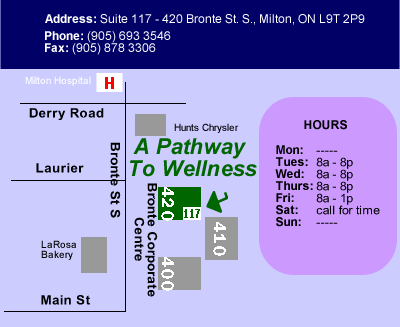
Experience
Alice has been a practicing registered massage therapist (RMT) since 1997 and has been using acupunture since 1999.
Hours
Monday - closed
Tuesday - 8am - 8pm
Wednesday - 8am - 8pm
Thursday - 8am - 8pm
Friday - 8am - 1pm
Saturday - call for times
Sunday - closed
Appointments
Yes, you need an appointment. Sometimes appointments can be booked within the day you call or that week. Try to call prior to 8am or early morning to catch any possible openings. Please keep in mind that the fall and winter months tend to be the busiest and very often you may need to make your appointment at least a week in advance. Evenings can be busy too, depending on the number of staff. There are a lot of commuters in Milton and we do are best staying open till 8pm to service you.
Remember this is a partnership, I can help you if you help yourself!
Please note that your appointment time and length has been reserved especially for you. Due to high demand for our services sudden cancellations, and no shows pose a problem in our practices. Such events result in direct loss of income to us. Therefore, we request 24 hours notice for an appointment change to avoid a cancellation fee of the full appointment cost.
Thank you for your understanding.
Will it hurt?
There may be some discomfort in a specific treatment used, but you control the amount of pressure given. Remember everyone’s opinion of what is painful is different. It does not have to hurt to be good for you or to work. Light and deep massages are available. No massage therapy treatment should reflect a “grin and bear it” attitude.
Acupuncture needles are barely felt upon insertion due to their fineness. When the needle reaches the required depth you may feel a slight dull ache or tingling sensation as it touches the Qi, the internal energy channel. This sensation only lasts for a second. During the rest of the treatment you should not feel any of the needles unless advised otherwise.